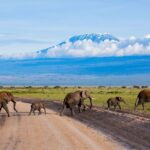
This Tsavo National Park destination guide begins in southeastern Kenya, where Africa’s wild heart beats strongest. Tsavo is actually two distinct parks—Tsavo East National Park and Tsavo West National Park—that together form the largest protected area in Kenya. Covering a staggering 22,000 square kilometers (8,490 square miles), this vast wilderness is one of the largest national park complexes in the world. The park was established in 1948 and has since become an iconic symbol of untamed African wilderness.
Tsavo East National Park, the larger of the two, spans approximately 13,747 square kilometers (5,307 square miles). It is characterized by vast, open savannah plains, the dramatic Yatta Plateau—the world’s longest lava flow stretching over 290 kilometers—and the life-giving Galana River. The park is world-famous for its “red elephants,” which acquire their distinctive rusty color from dusting themselves with the park’s red, iron-rich volcanic soil. Tsavo West National Park covers about 9,065 square kilometers (3,500 square miles) and offers a completely different landscape. Here you will find volcanic hills, ancient lava flows, natural springs, and the stunning Mzima Springs, which produce over 250 million liters of crystal-clear water daily.
The Tsavo ecosystem holds immense historical and cultural significance. The park is steeped in legend, including the famous “Man-eaters of Tsavo”—two lions that terrorized railway workers building the Kenya-Uganda railway in the late 19th century. Today, Tsavo serves as a vital wildlife corridor between Kenya and Tanzania, supporting some of the largest elephant populations in Africa. The park’s isolation from major cities has preserved its wild character, making it a true frontier destination for travelers seeking an authentic wilderness experience.
What makes Tsavo unique among Kenyan destinations is its incredible diversity within one ecosystem. Travelers can experience the wide-open, red-dusted plains of Tsavo East and then journey to the green oases, volcanic craters, and underground springs of Tsavo West. This remarkable variety of habitats—from arid scrubland to lush riverine forests—supports an astonishing range of wildlife and plant species found nowhere else in such concentration.
Before planning your visit, here are essential facts about this Tsavo National Park destination:
Timing your visit to Tsavo National Park can significantly shape your experience, as the landscape and wildlife viewing conditions change dramatically with the seasons.
Dry Season (June to October): This is the most popular time to visit Tsavo. With little to no rainfall, the vegetation becomes sparse, and wildlife concentrates around permanent water sources like the Galana River and Mzima Springs. Animals are exceptionally easy to spot in the open, dry terrain. The weather is warm during the day but cooler at night. This peak season offers the most rewarding wildlife viewing but also sees higher visitor numbers and accommodation rates.
Dry Spell (January to February): This brief dry period between the rainy seasons offers excellent wildlife viewing conditions similar to the main dry season. Wildlife congregates around remaining water sources, and the weather is generally pleasant. It is less crowded than June to October, making it a sweet spot for travelers seeking good value and quality wildlife encounters.
Wet Season (March to May and November to December): The long rains from March to May and short rains in November transform Tsavo into a greener, more vibrant landscape. While wildlife disperses across the plains, making sightings more challenging, this is an excellent time for birdwatching, as migratory species arrive in abundance. The dramatic skies, vibrant greenery, and lush vegetation offer stunning photography opportunities. Rates are lower, and the parks are much quieter. However, roads can become muddy and temporarily impassable, so a 4×4 vehicle is essential.
This Tsavo National Park destination guide highlights the diverse activities available across both Tsavo East and Tsavo West, catering to nature lovers, photographers, and adventure seekers.
Location: Tsavo National Park is located in southeastern Kenya, straddling Taita-Taveta and Kitui Counties. Tsavo East lies east of the Mombasa-Nairobi highway, while Tsavo West lies west of the highway. The park is approximately 240 kilometers southeast of Nairobi and about 150 kilometers northwest of Mombasa, making it accessible from Kenya’s two major cities.
By Road from Nairobi: The journey takes approximately 4 hours via the A109 highway towards Mombasa. The Voi or Mtito Andei gates provide access to the park. The roads are generally well-maintained, but a 4×4 vehicle is recommended, especially during the rainy season.
By Road from Mombasa: The journey takes approximately 2.5 hours via the A109 highway towards Nairobi. The park is located about 150 kilometers from Mombasa, making it a popular destination for coastal residents and visitors.
By Air: Chartered flights are available from Nairobi’s Wilson Airport or Mombasa’s Moi International Airport to several airstrips within the park, including Tsavo East’s Voi airstrip and Tsavo West’s Kilaguni airstrip. The flight takes approximately 45 minutes to 1 hour and offers breathtaking aerial views of the dramatic landscapes.
By Train: The standard gauge railway (SGR) from Nairobi to Mombasa stops at Voi, providing an alternative travel option. From Voi, it is a short drive to the park gates. This is a scenic and comfortable way to travel, especially for those combining a safari with a coastal beach holiday.
From Other Parks: Tsavo’s central location makes it an ideal stop on a Kenyan safari circuit. It is approximately 3 hours from Amboseli National Park, 5 hours from Maasai Mara, and 6 hours from Samburu. Many travelers combine Tsavo with Amboseli, Lake Nakuru, and the coastal beaches of Mombasa for a comprehensive Kenyan experience.
Tsavo National Park is one of Africa’s most important wildlife sanctuaries, and this Tsavo National Park destination guide highlights the incredible animals that call this vast wilderness home.
Visiting Tsavo National Park is an unforgettable journey into one of Africa’s most spectacular and wild destinations. Its vast scale, dramatic landscapes, and incredible wildlife make it a must-visit for anyone seeking an authentic African wilderness experience. The park’s accessibility from Nairobi and Mombasa, combined with its diversity of habitats and wildlife, makes it suitable for both first-time visitors and seasoned African travelers alike.
0 amazing safari experiences
No safaris available for this destination yet.
Contact us to create a custom itinerary.